
 Admin
Admin 
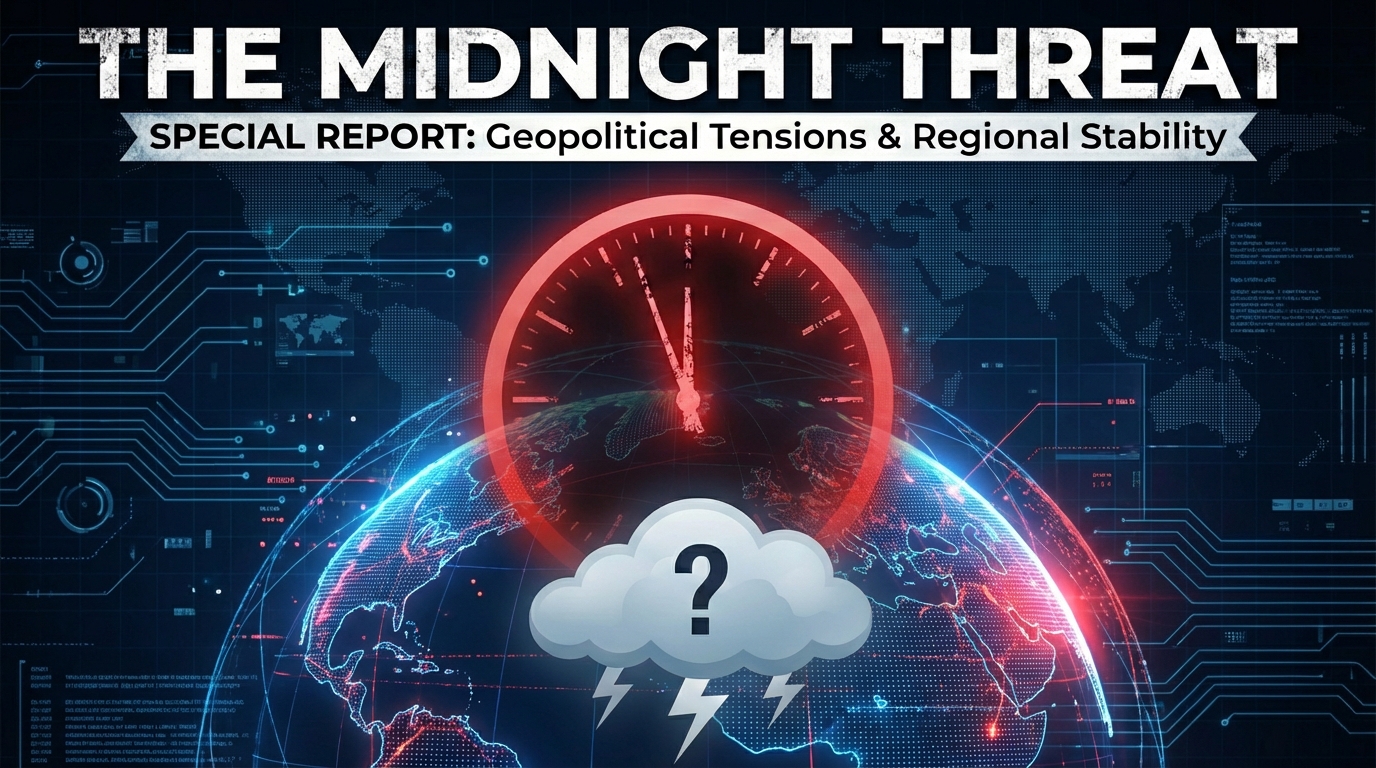
As of late February 2026, the geopolitical landscape of the Middle East is no longer just shifting; it is undergoing a violent and calculated transformation. With the U.S. administration signaling a “final deadline” for nuclear compliance and Israel shifting toward a doctrine of total preemption, the prospect of a kinetic strike on Tehran has become a looming reality. However, for a student of International Relations, the most dangerous variable is not the strike itself, but the underlying objective of forced regime change. This policy is underpinned by a “Nuclear Zero” rhetoric emerging from Tel Aviv, asserting that the global community must never allow an Islamic nation to hold nuclear power. For Pakistan, the world’s only Islamic nuclear power, this sets a terrifying precedent. If the world accepts the logic that Muslim states are inherently “existential threats” when armed with nuclear deterrence, Pakistan becomes the next logical target in a redesigned global order.
The year 2026 stands as a critical pivot point for Pakistan’s national security and regional standing. With Donald Trump back in the White House, providing unconditional diplomatic and military backing, Netanyahu is pushing for a total regional reset before the year concludes. This is not merely a localized conflict; it is the manifestation of the “Greater Israel” ambition frequently signaled by Netanyahu’s maps at international forums. These maps, which conspicuously ignore the traditional borders of Syria, Jordan, Egypt, Iraq, and Saudi Arabia, suggest a future where sovereign Arab and Muslim lands are subsumed under a new security architecture. If the Iranian regime falls, the resulting power vacuum will not lead to democracy, but to a “shelterbelt” of instability. This vacuum will bring Israeli influence directly to the borders of Turkey and deep into the Arabian Peninsula, permanently compromising the collective sovereignty of the Muslim Ummah.
For Pakistan, the threat is compounded by the strengthening of the Trump-Modi-Netanyahu triad. Israel’s most significant and strategic regional ally is India, and Netanyahu is actively working to ensure a seamless strategic “patch-up” between Trump’s isolationist tendencies and Modi’s regional ambitions. This creates a “Three-Front” nightmare scenario for Islamabad. While our eastern border remains perpetually tense, a regime change in Iran would transform our 900km Sistan-Balochistan frontier from a managed border into a gateway for chaos. History proves that forced regime change turns nations into playgrounds for foreign intelligence agencies. In this scenario, the convergence of RAW and Mossad interests along our western flank would directly target the China-Pakistan Economic Corridor (CPEC) and our deep-sea strategic assets in Gwadar. The goal is clear: to keep Pakistan internally distracted and externally paralyzed.
Beyond the kinetic threat, the economic implications would result in what can only be described as an “Inflationary Armageddon.” The Strait of Hormuz is the world’s most important oil chokepoint; a conflict there would spike Brent crude prices to a projected $150 per barrel. For a struggling economy like Pakistan’s, this would deplete the State Bank’s foreign exchange reserves within weeks, leading to a total collapse of the rupee. This economic pressure is worsened by the “$18 billion legal guillotine” involving the Iran-Pakistan (IP) Gas Pipeline. Forced regime change would essentially kill this project, depriving Pakistan of cost-effective energy and leaving us buried under international arbitration penalties. Furthermore, we must acknowledge that Pakistan lacks the humanitarian and social infrastructure to host another massive influx of displaced populations. Such a crisis would trigger internal ethnic friction and push our social fabric to its breaking point.
Moreover, we must view this through the lens of modern hybrid warfare. A post-regime-change Iran would likely become a hub for sophisticated cyber-attacks and proxy militancy directed at any state that challenges the new regional status quo. As a member of the Gen Z workforce and an IR scholar, I see this not just as a political shift but as a direct threat to my generation’s economic future and physical security. We are entering an era where the “Right to Deterrence” is being selectively denied to Muslim nations while being subsidized for others. This double standard in international law serves as a clarion call for Pakistan to reassess its traditional alliances.
Ultimately, the “Midnight Hammer” hovering over Tehran is a warning for the entire Islamic world. We can no longer afford the luxury of being passive observers or reactive players on the global stage. It is high time for Pakistan’s policymakers to engage in deep, uncomfortable introspection regarding our national stance. We must formulate an independent, “Pakistan-First” sovereign policy that prioritizes our national interest above external pressures or short-term financial baits. Our diplomatic framework must shift toward ensuring that our nuclear deterrence remains non-negotiable and our economic survival remains independent of regional collapse. We must use our diplomatic weight and strategic foresight to protect our borders and our right to exist as a sovereign power in an increasingly hostile world.
Author: Hamna Maqbool (A Student of International Relations, 7th Semester, University of Poonch Rawalakot, AJK)