
 Ayesha Hassan
  Ayesha Hassan
Ever since 2020, the SDG2 Zero Hunger goal has been pulled back by an entire lot of poly-crises war, climate stress, price hikes and supply-chain shocks -that drive most countries in the wrong direction. I suppose that developed countries can assist the underdeveloped ones to reach zero hunger, provided the nations stop their charity-only attitude and implement the 3-part action plan: (1) stabilize crises with predictable funding and shock-reactive safety nets; (2) develop the capacity of institutions that effectively transform money into concrete outcomes; and (3) reform the global rules, which are currently contributing to inequality, such as trade, supply chains, climate finance. This argument concurs with two bodies of evidence food systems that require systemic solutions, and institutions (governance, accountability, stability) are closely related to improved SDG-2 results.
Frankly speaking, the figures are quite shocking. SOFI 2025, 638-720 million individuals face hunger in 2024, and food prices have increased which has had an impact on our purchasing power and the capacity to afford healthy food. Worse still, GRRC 2025 reports that more than 295 million individuals were experiencing acute hunger in 2020, and 1.9 million individuals reached catastrophic levels. Evidently it is not merely a matter of production, but a question of access, stability and governance. The article I am reading first Towards the Sustainable Development Goal of Zero Hunger: What Role Do Institutions Play? By Jalini Kaushalya Galabada highlights that SDG -2 is stumbling over a group of related shocks and ineffective governance. It discusses existent global forces such as health crises, geopolitical hostility, and climate-related shocks and explains that the solutions must encompass governance, supply chains, production, and the way we eat. It even drives towards multi-scale governance and proposes strengthening the Committee on World Food Security to get it all in order.
The second article; Zero hunger: future challenges and the way forward towards the achievement of sustainable development goal 2 presents the so-called conversion mechanism: in 108 countries between 2000 and 2019, the higher the SDG-2 performance, the better the governance and political stability. Such aspects as voice and accountability and conflict prevention appear to be particularly crucial, particularly in developing countries where they as well enhance agricultural production and economic development. It already has a framework of policies, though they are not always quite enforced. SDG-2 has targets of financing agri R/D and extension (2.A) and repairing trade distortions (2.B). One practical application of enforceable international regulations is the case of the WTO in Nairobi removing agri export subsidies- evidence that even trade regulations can be amended with a political desire.
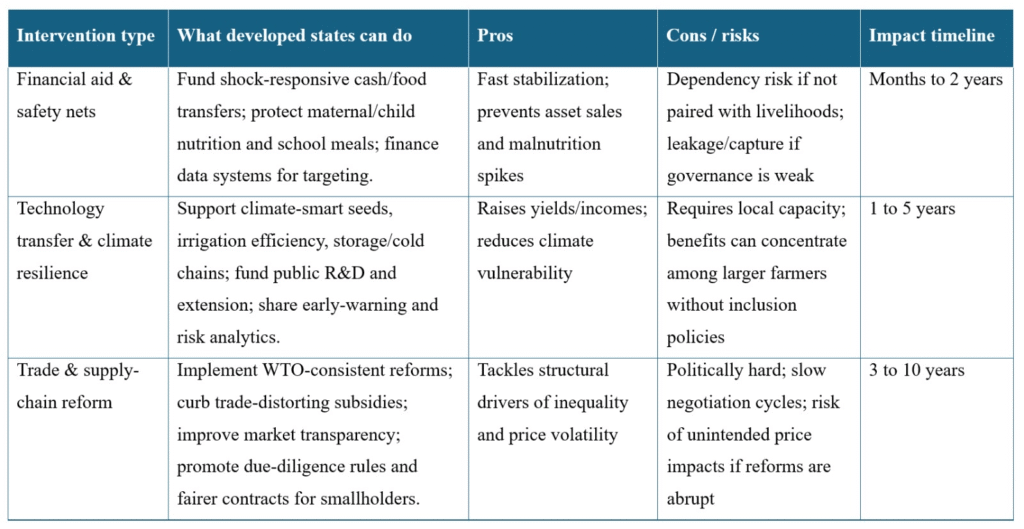
During the practical period (0 -24 months), the key objective is to reduce the fluctuation in food access. Essentially, the developed nations are supposed to establish predictable food and nutrition programs in a manner that governments develop shock responsive safety nets. GRFC cautions that humanitarian food funding may reduce significantly and this will have acute negative impacts on the services in child nutrition. The moral of the story is not to contribute more but to finance in a more gradual manner: in that way safety nets will be able to expand as prices rise, or droughts occur. We are going to the realistic phase (1-5 years) now and institutions begin to have more weight than the budget alone. According to the government paper, cash is not the only solution to food security- powerful institutions are. When you go digging on SDG2, you will find that it relates to voice, accountability, stability, and conflict prevention, particularly in the developing environment. Therefore, the developed countries ought to focus on anti-corruption, beneficiary registries, redress, and capacity building. Theoretical/systemic stage (3-10 years) occurs next, the incentive system of global food should be changed completely. The paper concludes that food systems are interconnected on a global scale, and the supply chains have demonstrated power dynamics in which the profits accumulate and risks are shifted to other parties. In that framework, the developed countries ought to advocate fair trade, corporate due diligence, reduce food waste and climate adaptation finance which in fact contributes to food security.
The way Islam approaches poverty and hunger is, it is an issue of rights and not charity. When we were in class, we read that being righteous is related to spending on relatives, orphans, the downtrodden and travelers. Among the most significant lessons is the fact that one of the most important social obligations is almsgiving tax, Zakat. When one community pretends that it does not see the other and does not even try to feed the poor, it is a failure not only personally, but also morally. And that is not only a matter of compassion, but it also demonstrates that money is not to remain in the hands of a small group of people. It is an ethical basis of reallocation of resources to ensure that all people can develop both physically and metaphorically. The other view that I have remembered is the medical-moral reasoning as held by the hadith- Al-Adab Al-Mufrad states that you are not a true believer when you are stuffed and your neighbor is starving. It is a harsh lesson that feeding is not an option. This is practically supported in the Quran 9:60 as we can find the categories of Zakat and it is basically a social finance rulebook that targets the poor and the needy, the debt-strapped, and the travelers stranded. It is as though an ethics lecture was put into practice. We have known historically of Bayt al-Mal, the state treasury in early Islamic economics, a governmental system to collect and redistribute money to charity. The book explains its growth during the reign of the first caliphs when the treasuries of the state were filled. Today, you can still find Islamic social finance being practiced via agencies that drive Zakat and food-security initiatives. To take just one example, Islamic Relief Worldwide engages in such activities as food distribution and assistance to small-holder farmers. The multi-billion-dollar Programme of the Islamic Development Bank Food Security Response, which collaborates with the WFP in nutrition and school meals, is another. These instances indicate that Islamic finance can support SDG-2 at large proportions.
A good example of how productivity gains combined with the consistent policies can transform the food situation are in Bangladesh. The World Bank states that Bangladesh has increased the food-grain production three times between 1972 and 2014, and attributes this to the continued investment in technology and rural infrastructure as the primary factor. It recently even increased three-fold the production of rice between 1971 and the present, however, the report warns that further increases will rely on mechanization, losses minimization, and climate-sensitive reforms. It demonstrates that progress is real, it is simply necessary to continue to upgrade the system. The Productive Safety Net Program in Ethiopia, Africa, displays the resilience that can be created with the help of external assistance and countrywide implementation to ensure that food security is kept under the control. A 2026 note by the World Bank proposes a 5-year safety-net strategy that would increase food security and remain resilient to climate change and emphasizes extensive coverage and the use of instruments such as improved monitoring and grievance mechanisms. What is important to note here is institutional: safety nets work more effectively when the process of delivery is both transparent and accountable- precisely the governance mechanisms picked by the paper as crucial. The third program impact is at scale, developed lens. When EBMJ conducted a difference-in-differences study of the Feed the Future program of the USAID, statistically significant increases in child nutrition were observed, with a 3.9-percentage-point greater reduction in stunting in the countries involved in the first years of the program. That is why the disciplined argument that carefully designed and assessed development programs can change human outcomes can be changed not only outputs. Below is a compact “policy bundle” which is actionable and institution aware.
Zero Hunger is rather difficult to achieve unless we approach the task of cranking up solidarity on the planet and constructing better local institutions. The systems lens puts one in a position to understand why hunger continues to recur in the poly-crisis situations and why the patchy interventions simply fail to work. The governance lens demonstrates that those resources can be converted to better SDG- 2 by accountability and stability. The Islam argument receives a fair boost when we set food security in the context as both an obligation, i.e. by the zakat categories that are directed by explicit rules, and a social value, e.g. feeding your neighbor. Both the social-finance and the humanitarian models supported by that dual framing are quite consistent with SDG-2.