
 Hafsa Imran
  Hafsa Imran
Afghanistan’s domestic politics is complex because of the presence of different militant groups, which have effects on legislation, while the behavior of international actors dictates the regional balance.
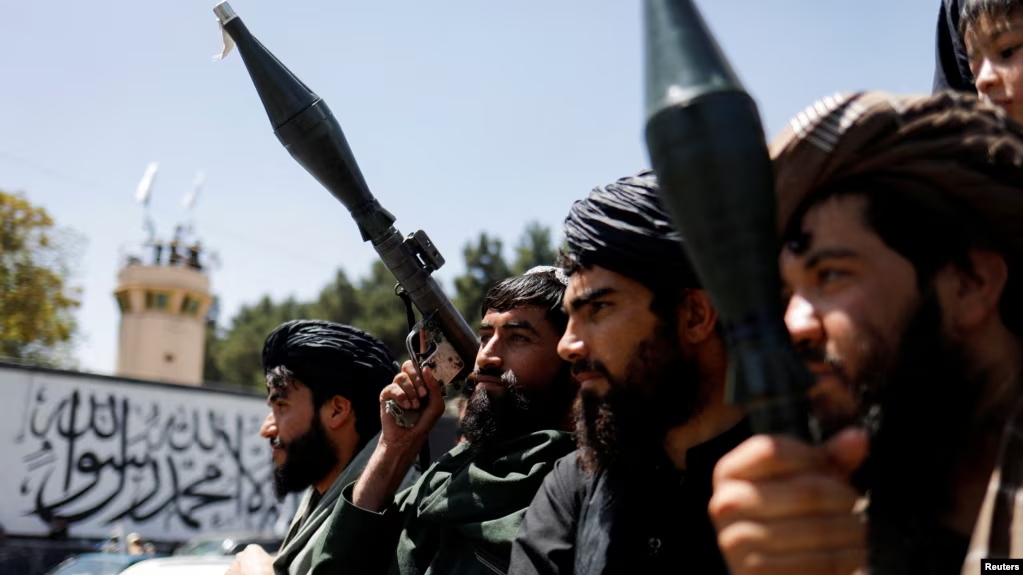
The current Afghanistan situation has a ripple effect on its foreign policy, creating a “legitimacy paradox.” Afghanistan’s ideological rigidity is fabricating the barrier for it, creating diplomatic isolation. From 2021 onwards, after the overthrow of Ashraf Ghani’s government, the Taliban took control, leading to a theocratic state known as the Islamic Emirate of Afghanistan. The Taliban follow the Sunni sect, majority of the Hanafi school of jurisprudence. The state has abrogated the constitution and follows the Institutionalization of Shariah Law. The supreme authority is exercised by the Amir al-Muminin, Hibatullah Akhundzada. Late 2025 reports suggest the deepening of the Kandahar vs Kabul crisis, where in Kandahar there is ideological leadership and Kabul constitutes the administration. While they share the same core ideology, they also disagree on how to function the state. The Kandahar leadership favors total international isolation, strict imposition of religion, and a complete ban on female education and work, meanwhile the Kabul faction pragmatically disagrees on international isolation. In December 2025, Sirajuddin Haqani gave a speech in which he stated that the government must not rule through “fear and force” but must earn the “consent of the people.” Other than this, several ministers have highlighted the importance of female education on different occasions, such as Sher Mohammad Abbas Stanikzai, the deputy Foreign Minister, who is the most critical within the government. This shows the divergent state-run policy from the Kandahar leadership.
Afghanistan, which is also known as the “Graveyard of Empires,” is now a state where there is null enforcement of the constitution, resulting in the creation of an environment of more propaganda and pessimistic narrative-building in the name of religion, forming a pariah state. Under the De Facto authority, the region has seen a spike in the presence of different groups such as the Islamic State Khorasan Province (ISKP/ISIS-K), Al Qaeda, Tehreek-e-Taliban Pakistan (TTP), and Tehreek-e-Jihad Pakistan (TJP). The TTP used to attack Pakistan because of the official patronage they enjoyed from the Taliban regime. A clear example is the 9/11 terrorist attack, which ultimately dictated the world foreign policy and led to the launch of the war on terror to dismantle Al Qaeda. The presence of these groups has created significant tensions and affected regional stability; moreover, the presence of different groups affects the confidence of relations with the US, China, and Russia.
Since Afghanistan is a landlocked country, it highly depends on its neighbors for trade purposes. Historically, Pakistan has played a crucial role by providing transit routes to Karachi port, although it can be complicated due to political tensions, so the country also relies on the Chabahar port of Iran. There has been a massive State-led repatriation campaign for the forced return of Afghan refugees from Pakistan and Iran. As of December 2025, around 942,200 Afghans were returned from Pakistan, bringing the total return from Pakistan and Iran to 2.8 million in 2025. Afghan soil has been tremendously used for leveraging security concerns and exploiting the internal fault lines, primarily in the neighboring countries. According to the Global Terrorism Index, Pakistan is ranked as the second most affected country by terrorism, with a 34 percent increase on the graph. The Tehreek-e-Taliban Pakistan’s entrenched presence has made KPK experience the highest number of terrorist incidents in the country in 2025, with 413 attacks. As of the beginning of 2026, there have been multi-province border offensives. The operation “Ghazab-Lil-Haqq” was launched by Pakistan to counter terrorism, raising a “State-on-State Conflict.” The operation was a direct response to Afghan disruptions in the region. The primary target was the Taliban military headquarters. According to data provided by the Government of Pakistan, 237 Taliban posts were destroyed; 520+ Taliban fighters were killed, and a state of Open War was declared. This was a necessary step taken by Pakistan to protect its soil, which was becoming fragile from such disruptive movements and radical ideology. It will affect trade deals and create chaos in the region; moreover, ISIS-K targets Shia mosques and gatherings. Recruitment is conducted from Central Asia to Afghanistan to strike in Iran. The Peoples Fighters Front, formerly known as Jaish-e-Adl, focuses on hit-and-run attacks against the Islamic Revolutionary Guard Corps (IRGC, the shadow government).
From a geopolitical perspective, Afghanistan is frequently cited as a proxy theater of global and regional powers. Its strategic location connects it with South Asia, the Middle East, and Central Asia. For example, with Pakistan, there is friction between the Taliban government and Pakistan’s government. Islamabad repeatedly records its protest that Afghan soil is used for terrorism in Pakistan, and the Taliban are unable to control the military activity. The situation escalated during October 2025, when Pakistan conducted airstrikes in several cities of Afghanistan, the most notable being Kabul, Jalalabad, Khost, and Paktika. The primary target was the Pakistan Taliban, especially Noor Wali Mehsud. During these strikes, the Afghan Foreign Minister Amir Khan Muttaqi was in New Delhi for an official visit, which ultimately defined Afghan economic interests and India’s strategic interests, due to longstanding tensions with Pakistan. They are also using soft power by building relations with Kabul, as it can provide a strategic advantage. To counterbalance India’s increasing influence, Pakistan and China came together with their interest-based approach of a Trilateral agreement to include Afghanistan in the China Pakistan Economic Corridor. This will enhance economic cooperation to address terrorism and will promote peace and stability in the region, especially in KPK. Afghanistan also has economic outreach with Russia and China. There have been reports of mining contracts involving Chinese and Russian companies in Afghanistan. These often relate to the extraction of resources like lithium, copper, and other minerals. The Gochin China firm in 2023 declared its intention to invest in lithium reserves and proposed a 10 billion dollar investment package, but due to regional security concerns and targeting of Chinese nationals, the process was terminated. According to the US Geological Survey and SIGAR, reports suggest that the mineral resources have an estimated value of $1 trillion. Currently, the Xinjiang Central Asia Petroleum and Gas Company (CAPEIC) is the most successful foreign extraction project, having generated approximately $137 million in revenue in 2025, although it was also terminated by the Afghanistan regime citing that CAPEIC failed to meet investment commitments.
In the international system, internal problems lead to Afghanistan being used as a regional political tool. Proxy wars, human rights violations, and the presence of radical leadership have created a refugee crisis. People migrate illegally to Pakistan, Iran, and Europe; moreover, the lack of a check-and-balance system creates hurdles for proper resource management and affects Foreign Direct Investment (FDI). Recently, the Afghan parliament enacted a law that legalized gender-based violence by granting permission to beat women to such an extent that their bones are not broken. Women there are forced to beg to fulfill their basic needs. Meanwhile, in certain cases, they disguise themselves (Bacha Posh) to feed their families. The Afghan government has no laws to provide resources to families with no men to provide. One such case is of a 13-year-old girl, Noor Ahmad, aka Nooria, who disguised herself as a boy in order to work and support her family. Her story has highlighted the crises in regions with no opportunities. This suggests that, in the prevailing world order, the Taliban must make certain paradigm shifts to deter radicalism and take actions to prevent its soil from being used by different militant groups. Furthermore, it must take necessary steps to ensure human rights, so that it will be beneficial for Afghanistan to be recognized by the United Nations and attract investments for economic prosperity. There is a need to balance relations with neighboring states to prevent the country from becoming a hub of proxy conflicts, as trade is essential for economic upliftment.
The writer is currently pursuing her Bachelors in International Relations from National University of Modern Languages (NUML), Islamabad.