
 Syeda Arooj Fatima
  Syeda Arooj Fatima
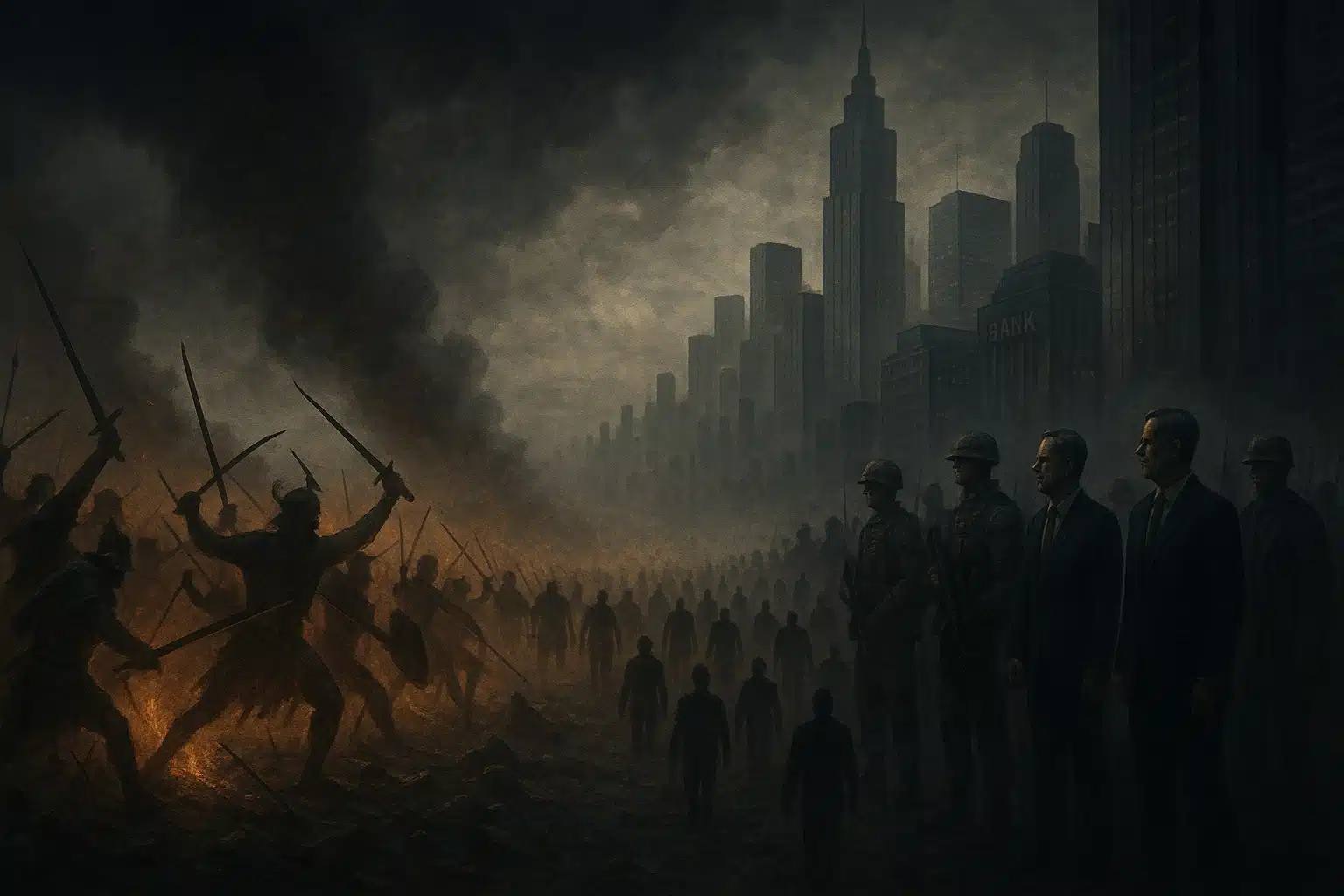
There is a kind of arrogance that modern societies rarely examine in themselves the quiet, almost reflexive assumption that our age of satellites, drone warfare, and real time intelligence has left the ancient strategists somewhere behind us. We glance at Sun Tzu on airport bookshop shelves and allow ourselves a private smile, as though looking at a curiosity from another world. We shelve Clausewitz under military history. We forget Machiavelli the moment the classroom door closes behind us. And then as if on cue the world catches fire. In Ukraine, in Gaza, across the Taiwan Strat and every headline, if you look carefully, reads like a page torn from a manuscript written two and a half thousand years ago.
The great strategic thinkers were not merely chronicling the conflicts of their own lifetimes. They were mapping something deeper the permanent grammar of human conflict, the logic that persists beneath the chaos, the architecture of power that endures beneath the rubble of any particular war. To read them now is not an exercise in nostalgia. It is, in the most urgent sense, an act of diagnosis.
Know Your Enemy And We Often Do Not
Sun Tzu,s most repeated line If you know the enemy and know yourself, you need not fear the result of a hundred battles has the deceptive quality of all genuinely profound ideas: it sounds obvious until you realize how rarely anyone actually does it. The principle is ancient. The failure to apply it is apparently eternal.
Consider the Russian invasion of Ukraine, launched in February 2022 with a catastrophic confidence that the Kremlin had done exactly what Sun Tzu demanded. It had not. The opening calculation was wrong at almost every level a government expected to collapse within days, a population assumed to be indifferent to resistance, an alliance in the West assumed to be too fragmented to respond with any real coherence. Four years on, the war continues as a grinding, inconclusive stalemate one that has bled Russia of manpower, economic standing, and a good deal of the international credibility it had spent two decades accumulating.
Sun Tzu saw this coming too. He was explicit on the dangers of prolonged warfare: There is no instance of a country having benefited from prolonged warfare. The observation is not complicated. But it requires a degree of honest self-assessment about your own weaknesses as much as the enemy’s strengths that powerful states almost invariably resist.
Ukraine, meanwhile, has demonstrated a different Sun Tzu principle in action. A smaller force, fighting on ground it knows and cares about, animated by a genuine sense of national purpose, has consistently and unexpectedly outperformed a larger, better equipped invader that lacked any comparable clarity of purpose. The lesson is not new. The weapons, yes the drones are newer than anything Sun Tzu imagined. The underlying dynamic is not.
Clausewitz in Gaza When War Loses Its Purpose
War is merely the continuation of politics by other means.
Carl von Clausewitz, On War (1832)
If Sun Tzu is the strategist of precision and elegance, Carl von Clausewitz is the strategist of hard, uncomfortable truth. His most important contribution to strategic thought was not a formula for winning wars. It was an argument about what wars are for and what happens when that question is left unanswered.
Gaza presents a Clausewitzian problem in real time, and it is worth being precise about what that problem actually is. Since October 2023, Israel has prosecuted a campaign of extraordinary military intensity. Measured by conventional military metrics infrastructure degraded, territory controlled, adversary leadership targeted the results have been significant. And yet, when measured against Clausewitz actual standard what political objective has been secured, and is it durable? the answer becomes far less clear.
Clausewitz was explicit about this trap: military action without a defined, achievable political end does not just fail to resolve a conflict. It can actively consume the political goals that justified the action in the first place. When the rubble accumulates and there is still no coherent framework for post war governance, no credible diplomatic architecture, no answer to the question of what comes next military success, however total, operates in a vacuum. The operation achieves tactical dominance; the war achieves strategic drift. That gap between what is militarily accomplished and what is politically produced is exactly where Clausewitz located the gravest danger.
There is a further irony here that Clausewitz would have appreciated. Hamas whatever one thinks of its methods has absorbed the Clausewitzian logic in its own way. Its survival does not require military victory over Israel. It requires only that the perceived cost of eliminating it exceeds the perceived benefit. That is a political calculation operating under military cover. It is, in every meaningful sense, the continuation of politics by other means. The ancient framework applies to both sides of the equation.
Machiavelli’s Prince Now Governing from Beijing and Washington
Machiavelli has been done a great disservice by his reputation. He is remembered as a theorist of cynicism and cruelty the philosopher of the ends justifying the means. What he actually offered was something far more unsettling and far more useful: an honest account of how power works, stripped of the flattering fictions that rulers and their admirers prefer.
The US China rivalry the defining strategic competition of the current era unfolds with a Machiavellian logic on both sides that its participants would probably rather not acknowledge. China’s strategy over the past four decades has been almost textbook in its patience: build economic interdependence with as many partners as possible, extend infrastructure investment through the Belt and Road Initiative, assert territorial claims in the South China Sea incrementally rather than dramatically, and accumulate leverage before exercising it openly. Machiavelli counseled exactly this the prince who builds quietly and strikes decisively, rather than the prince who announces his ambitions before he has the means to realize them.
The United States has responded with its own set of Machiavellian tools: the targeted technology embargo, the trade war deployed as strategic pressure, an alliance architecture carefully designed to encircle without provoking the kind of direct confrontation that would force a choice neither side is ready to make. Both powers are engaged in what Machiavelli would recognize as the management of Fortuna the unstable, unpredictable currents of events through the application of disciplined strategic will. Neither is simply reacting. Both are trying, in their different ways, to shape the terms on which the next decade unfolds.
The danger Machiavelli identified, though, was not the prince who lacks ambition. It was the prince who mistakes tactical cleverness for strategic wisdom who wins every skirmish of perception and prestige while losing sight of the deeper question: what kind of order are you actually trying to build, and will others accept it? That question hangs unanswered over both Washington and Beijing. And in Machiavellis experience, the longer it goes unanswered, the more destructive the eventual reckoning tends to be.
Thucydides Trap, the Fear That Starts Wars Nobody Wants
The growth of the power of Athens, and the alarm which this inspired in Sparta, made war inevitable.
Thucydides, History of the Peloponnesian War (5th century BC)
Of all the classical thinkers who feel most present in today,s headlines, Thucydides may be the most urgent. His account of why Athens and Sparta went to war despite, on some level, neither fully wanting it has given its name to one of the most dangerous recurring patterns in the history of international relations.
The argument was deceptively simple. It was not Athenian aggression that made war inevitable. It was not even Spartan malice. It was fear the fear of a dominant power watching a rising power close the gap, and the almost inevitable miscalculations that followed on both sides. This dynamic what the political scientist Graham Allison has called the Thucydides Trap describes the US China relationship with an accuracy that is, depending on your disposition, either clarifying or deeply alarming.
The historical record is not encouraging. In twelve of sixteen historical cases over the past five centuries where a rising power challenged a ruling one, the outcome was war. The exceptions share a common feature: deliberate, sustained diplomatic management of the transition, a mutual recognition of interests on both sides, and a conscious effort to contain the fear before it became self-fulfilling. The Cuban Missile Crisis of 1962 is perhaps the most dramatic modern example two nuclear powers standing at the edge of catastrophe and choosing, in the end, to manage the fear rather than act on it.
Today, the Taiwan Strait is where Thucydides lives. Every Chinese military exercise around the island, every American arms package dispatched to Taipei, every carrier group sent into the South China Sea is a move in a dynamic that Thucydides mapped more than two thousand years ago. The rational case for avoiding war is overwhelming both powers have far more to lose from a military conflict than either has to gain. But Thucydides point was never that rational actors choose war. It was that fear, misreading, and the pressure of domestic politics can lead rational actors into irrational outcomes. That warning has not expired.
What the Ancients Say That the Analysts Won’t
Modern strategic analysis is, in many respects, impressively sophisticated. It has access to data that classical thinkers could not have imagined, such as satellite imagery, signals intelligence, economic modelling, and real-time public opinion tracking. And yet it carries a peculiar blind spot: the tendency to treat each new conflict as fundamentally novel, as though the particular technologies and, actors and geographies of the present moment have somehow suspended the deeper patterns that have governed human conflict for millennia.
The classical thinkers offer a corrective to this. They remind us that beneath the specific, the general persists. War, in the end, has always been about what Thucydides identified as its permanent drivers: fear, honor, interest, and the desire for power. Strategy has always been, at its core, the attempt to align the means available with the ends desired and the catastrophe that follows when that alignment breaks down. Political violence has always required a political answer, or it consumes the very goals it was supposed to serve. These are not historical observations. They are the operating conditions of every conflict currently unfolding.
The world right now is running several simultaneous experiments in strategic failure. A war of attrition in Europe that neither side can cleanly win, fought at a cost neither side originally anticipated or desired. A military campaign in the Middle East that has achieved a kind of tactical dominance while generating strategic bewilderment about what comes next. A great power competition in the Pacific that is balanced, with increasing precariousness, on the knife edge of misperception and miscalculation. None of these crises suffer from a shortage of military power or political will. What they suffer from what they have always suffered from is the failure to integrate means, ends, and the kind of strategic wisdom that the classical thinkers spent their lives trying to articulate.
Perhaps the most honest conclusion available is simply this: the ancients are not obsolete. We are, simply, very slow students.
There is still time there is, theoretically, always still time to apply the lessons properly. To know the enemy and to know oneself before committing to a course of action that cannot easily be reversed. To keep the use of force tethered to achievable political purposes rather than allowing it to become an end in itself. To manage the fear that pulls great powers toward the Thucydides precipice before the fear manages them. To recognize that the prince who mistakes cleverness for wisdom tends, eventually, to pay for the confusion usually in someone else blood.
The classical thinkers asked hard, uncomfortable questions. They did not offer easy answers. In a world currently on fire in several directions at once, that habit of mind is not a luxury. It is a necessity.